
Table Top Ideas That Will Transform Any Room Design

Let me be real with you for a second. I spent years thinking my living room looked “fine” decent couch, okay rug, matching curtains and still couldn’t figure out why it felt off. Turns out, the table top was doing absolutely nothing for the room. Not the color of the walls. Not the lighting. The table. Once I swapped it out for something that actually made sense in the space, the whole room changed. Like, genuinely changed.
And I’m not the only one who’s had this realization. Interior designers across the US from boutique studios in Austin to big-name firms in New York keep coming back to the same point: the table top is one of the most underestimated surfaces in any home. People agonize over sofas and backsplashes, then just grab whatever table fits the dimensions. It shows.
So if you’re trying to figure out how to refresh a room without a full gut renovation, start here. Start with the table top.
Wood Table Top The One That Never Lets You Down
Okay, I know. Wood feels like the “obvious” answer. But hear me out, because there’s a reason designers keep coming back to it — and it’s not because they’re lazy or playing it safe.
A wood table top just does something no manufactured material can fully replicate. It has texture, variation, personality. Two pieces of walnut from the same tree look completely different, and that’s the whole point. Your space ends up with something genuinely unique rather than a surface that looks like it came off a factory line because, well, it kind of did.
Right now in the US, the big wood trends are reclaimed and live-edge. Reclaimed wood table tops the kind sourced from old barns, factories, warehouses have this incredible worn-in quality that takes decades to develop naturally. People are putting them in farmhouse kitchens in the Midwest, industrial lofts in Brooklyn, even beachy dining rooms along the Gulf Coast. They just work.
The Wood Table Top Stuff Nobody Tells You
Here’s what designers mention that most articles skip over. Soft woods look gorgeous in the showroom and get destroyed in about eight months if you have kids or a dog. Go with something harder maple, white oak, hickory. They hold up. Also, that raw unfinished wood table top look? Beautiful. High-maintenance. You need to seal it properly or one spilled glass of red wine will haunt you forever. Ask about finish options before you buy a hardwax oil gives you that natural look with way more protection than raw wood alone.
Table Top Fire Pit Your Outdoor Space Deserves This
I genuinely think the table top fire pit is one of the best things to happen to outdoor entertaining in the last decade. That’s not an exaggeration. Before these became widely available, if you wanted ambiance in your backyard, you either committed to a permanent built-in fire pit (expensive, permanent, requires permits in some states) or you bought one of those clunky freestanding units that takes up half the patio.
A table top fire pit sits right on your existing outdoor table. Clean, compact, and honestly it looks really good. The good ones run on bioethanol or propane, which means zero smoke, zero ash, and no cleanup beyond wiping down the exterior. You just light it, eat your dinner, have your drinks, and actually enjoy being outside after dark.
Matching a Table Top Fire Pit to Your Space
Sizing is everything here. A round, compact table top fire pit works perfectly on a small balcony or apartment patio think folks in Chicago or Phoenix with 80 square feet of outdoor space max. If you’ve got a full patio setup, one of the longer rectangular table top fire pit designs creates this incredible centerpiece effect that the whole table can gather around.
Material-wise, concrete is having a huge moment. It pairs well with modern outdoor furniture and weathers beautifully over time. Brushed stainless gives you something more minimal. The one thing to check before you buy make sure the base of your table top fire pit has adequate heat protection so it’s not sitting directly on a wood table top or any surface that could be damaged by warmth over time.
Epoxy Table Top Okay, These Are Actually Stunning
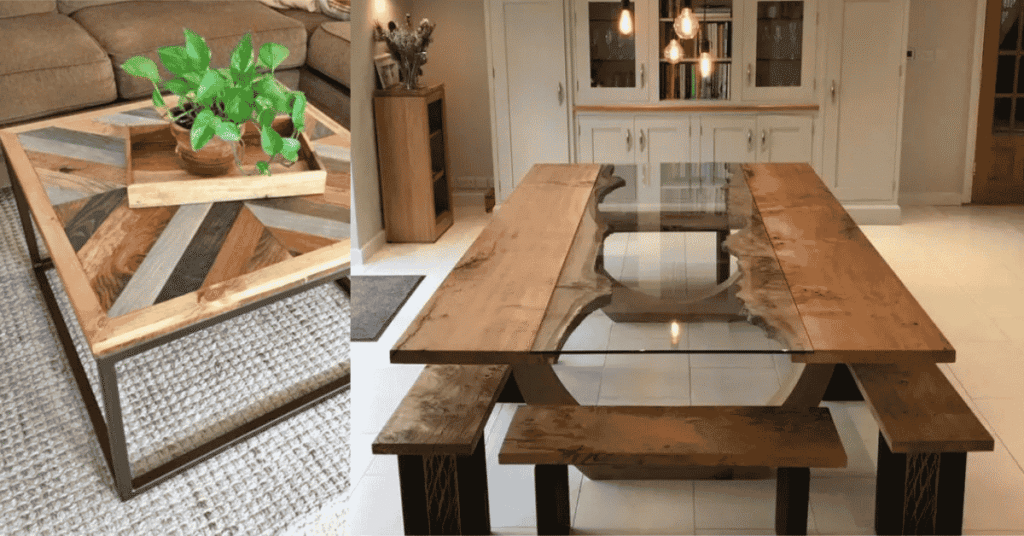
If you haven’t seen a well-done epoxy table top in person, pictures still don’t fully capture it. There’s a depth to the surface a sort of three-dimensional quality that’s hard to explain until you’re standing in front of one.
The basic idea: liquid resin is poured over a surface, usually a wood slab, and cured into a rock-hard, smooth finish. Simple enough. But what you can do within that process is where it gets wild. Designers are adding pigments that create flowing river effects through live-edge wood. Others are embedding botanicals, stones, or metallic powders. Some go full abstract with layered colors. Every single epoxy table top that gets made is completely one of a kind and that’s a genuinely rare thing to say about furniture.
Practically speaking, an epoxy table top is tough. Properly cured resin is waterproof, resistant to most household chemicals, and easy to wipe clean. For a kitchen island or a dining table in a busy household, that’s a pretty serious selling point. It also happens to be one of the best ways to rescue a damaged wood table top if yours has years of rings, gouges, or staining, a well-done epoxy pour can bring it back completely rather than replacing it.
Where Designers Are Actually Using Epoxy Table Tops
Statement dining rooms, mostly. A live-edge walnut slab with a deep teal resin river running through the center that’s the piece the whole room gets designed around. Home bars and kitchen islands are another big use case. And lately, more designers are doing epoxy table tops in home offices something about working at a surface that feels genuinely custom apparently does something for your headspace. Hard to argue with that.
Table Top Grill Big Flavor, Small Footprint
Let’s talk about the table top grill, because this one doesn’t get nearly enough credit in the outdoor living conversation. Not everyone has the yard space or the HOA permission for a full outdoor kitchen setup. The table top grill exists specifically for those people, and it genuinely delivers.
What makes a table top grill different from other compact cooking options is the counter-height ergonomics. You’re cooking at a comfortable level, which sounds minor until you’ve spent an entire summer hunching over a low charcoal setup and your back is done. A table top grill sits on your existing outdoor table, at a height that actually makes cooking enjoyable.
In cities like Miami, San Francisco, and Seattle where outdoor space is tight and people still love to cook outside the table top grill has become a legitimate solution rather than a compromise. Cast iron versions give you excellent heat retention and those sear marks that make grilling worth the effort. Gas and propane models offer more temperature control, which matters if you’re cooking fish or anything else that punishes you for getting the heat wrong.
Using a Table Top Grill Safely
This comes up a lot: make sure whatever surface your table top grill sits on can handle the heat. A metal or stone outdoor table top is ideal. Placing a table top grill on a painted wood surface or anything with a finish that could bubble or warp under sustained heat is asking for trouble. Most manufacturers are pretty upfront about this, but double-check before the first cookout.
Styling Your Table Top Without Overthinking It
You’ve sorted the actual surface. Now the styling part which, for what it’s worth, designers say most people genuinely overthink.
The instinct is usually to either cover the whole table top with stuff or leave it so bare it looks like a staging photo. Neither feels like home. What actually works is giving the surface some breathing room while anchoring it with a few intentional objects. A ceramic bowl, something with height (a small plant, a candlestick), and one textural element woven, metal, whatever suits the room. That’s usually enough.
And the material of your table top should inform what goes on it. A heavily grained wood table top can handle more visual noise because the surface itself is already doing a lot. An epoxy table top with a bold color or pattern? Let it be the feature. Keep accessories minimal so they don’t compete.
FAQs
Q: What’s the best wood table top material for a home with kids?
Hard species like maple and hickory handle daily beating well. Seal them properly and they’ll age gracefully instead of just looking wrecked.
Q: Is a table top fire pit safe on an apartment balcony?
Bioethanol and propane models generally are, but always check your building rules first. Most city apartment buildings restrict open flame on balconies some make exceptions for enclosed bioethanol burners.
Q: How long does an epoxy table top last?
Decades, if it’s done right. The main enemy is prolonged UV exposure, which can yellow the resin over time. A UV-stabilized topcoat solves most of that.
Q: Can a table top grill replace a regular grill for most cooking?
For everyday use steaks, burgers, vegetables, fish yes, a quality table top grill handles it all. It’s not ideal for smoking or cooking for a crowd of twelve, but for regular weeknight or weekend cooking, it’s completely capable.
Q: How do I protect a wood table top long-term?
Seal it with a hardwax oil or polyurethane depending on your use level, use coasters consistently, and re-apply finish every one to two years on high-traffic pieces. Wipe spills immediately especially anything acidic.