Bathroom Cabinet Ideas That Maximize Storage in Small Spaces
A small bathroom can turn into chaos within a single morning. The toothpaste never makes it back into the drawer, hair products pile up on the counter, and spare towels just get stuffed wherever there’s room. Anyone living in an apartment, an older home, or dealing with a guest bath knows this problem well there’s rarely enough floor space, so the vanity ends up carrying most of the load.
The good news? You don’t actually need a bigger room to fix this. A better bathroom cabinet setup is usually enough to make the whole space feel calmer and easier to live with.
Start By Emptying Everything Out
Before you organize anything, take it all out first. Most people end up trying to arrange products that should’ve been tossed months ago.
Go through expiration dates on medicine, sunscreen, makeup, and skincare. Toss the empty bottles, old samples, tools you never use, and duplicates you forgot you had. Once that’s done, sort what’s left into a handful of simple groups — dental care, hair products, skincare, first aid, cleaning supplies, backups.
Resist the urge to get too specific with categories. Five or six broad groups are far easier to keep up with than twenty tiny ones.
Measure Before You Buy Anything
Bathroom cabinet storage only works well when the organizers actually fit the space. Take the time to measure the width, depth, and height of every shelf. For anything going under the sink, account for pipes, valves, hinges, and the inside edge of the doors too.
A lot of bins look compact in photos but turn out too deep once you try to fit them in a vanity. Leave room for the doors to shut properly and for bins to slide in and out without snagging on plumbing.
Even a rough sketch helps here — just note where the tall gaps, shallow spots, and awkward corners are before you go shopping.
Don’t Waste the Space Above Short Products
Most cabinets have a good chunk of dead air sitting above jars and short bottles. A shelf riser fixes this instantly, turning one shelf into two usable levels without any real installation.
Put taller products on one side, smaller ones on the riser above. Shallow stackable drawers work well for the small stuff — razors, cotton swabs, hair ties, nail clippers, spare toothbrush heads.
Keep things within easy reach. If grabbing your face cream means moving five other things first, the shelf’s too packed.
Pull-Out Bins Solve the Deep Shelf Problem
Deep shelves hold a lot, sure, but whatever’s at the back tends to get forgotten. Pull-out bins fix that by bringing an entire category forward in one motion.
Dedicate one bin to hair care, another to extra toiletries, and keep a smaller tray just for first-aid items. Bins with handles tend to work best on the lower shelves.
Clear bins let you see at a glance what’s running low; solid ones just hide the clutter of mismatched packaging. Either works fine as long as each bin has one clear job.
Bathroom Cabinet Storage Under the Sink
This is usually the trickiest part of any setup, mainly because the plumbing cuts right through the middle of the space. Rather than fighting it, just build your storage around it.
Tall bottles go on the left and right. A low, washable tray fits nicely in the center for sponges, cloths, extra soap, or refills. A compact turntable also works well tucked into a corner.
One thing worth watching: keep paper products away from any exposed pipes. Even a small leak can ruin tissues, toilet paper, or cardboard packaging fast. Cleaning liquids are safest kept inside a removable tray, just in case of spills.
Make Use of the Cabinet Door
The inside of the door is easy to overlook, but it’s great for small, lightweight items. Slim adhesive pockets can hold toothpaste, combs, nail files, hair ties, or travel-size bottles.
Test the placement with removable tape first, and close the door slowly to make sure nothing hits the shelves before committing.
A magnetic strip is handy for tweezers and nail clippers. Just keep heavier containers and glass bottles on the main shelves — no point risking a door full of glass swinging shut.
Consider a Wall-Mounted Option
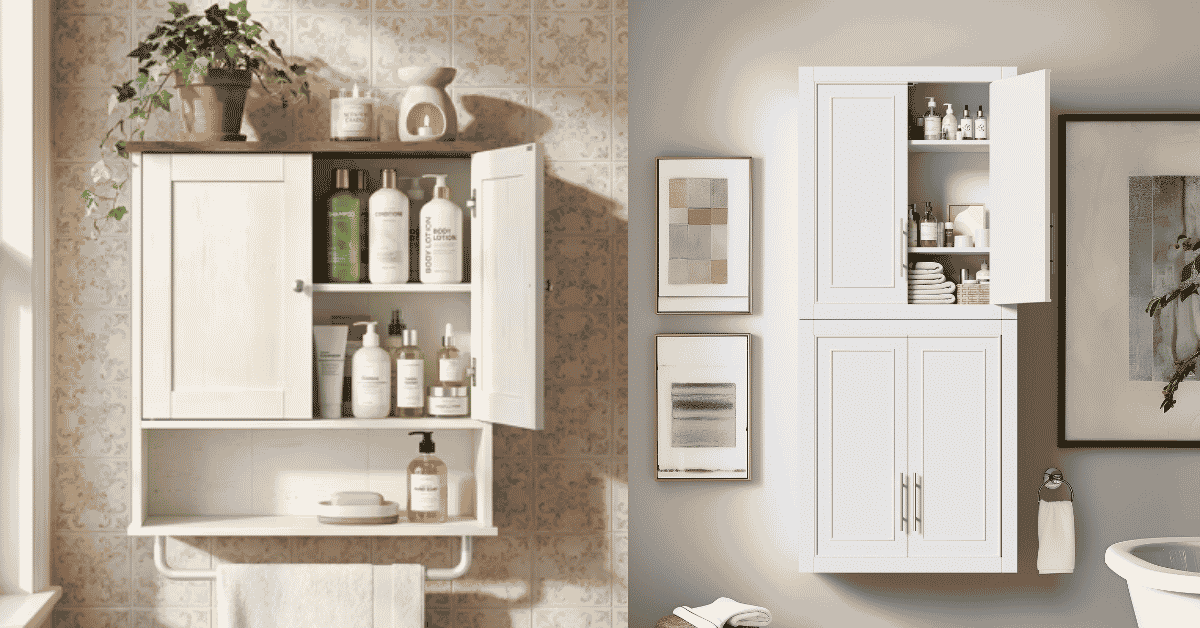
When floor space runs out, the next move is going up. A shallow wall-mounted bathroom cabinet can sit above the toilet, beside the mirror, or over a towel bar.
A mirrored option does double duty closed doors hide the clutter, while a narrow open shelf underneath can hold hand towels or a few everyday products.
Stick to moisture-resistant materials and hardware that won’t rust. Furniture built for a dry room tends to warp fast in a humid bathroom.
Setting Up Bathroom Cabinet Storage for Shared Bathrooms
Shared bathrooms need clear lines drawn early. The easiest fix is giving each person their own drawer, bin, or shelf.
Daily products stay in that person’s section. Shared items toothpaste, soap, first-aid supplies can live in the middle, accessible to everyone.
In a family bathroom, kids’ products are best kept on a lower shelf where they can reach them. Medicine, razors, and anything sharp should go higher up or into a compartment that locks.
Keep Backups Out of the Daily Rotation
Don’t let unopened replacements mix in with what you’re actively using. Keep just one shampoo, one toothpaste, one cleanser in the daily-use spot, and store extras in a separate backup bin.
This one habit alone makes the whole system easier to manage and it stops you from buying duplicates you already have. Get in the habit of checking the backup bin before your next store run.
Also, don’t try to fill every inch of space. Leaving a little room makes it easier to clean, shuffle products around, or add something new later.
Pick Organizers Based on What You Actually Own
Matching bins might look nice, but they’re not always the most practical choice. Tall bottles need open bins. Small tools need shallow trays. Cleaning products need something leak-resistant at the base.
A useful setup really comes down to how your household actually uses the space. Someone with a large skincare collection needs a completely different layout than a family sharing one sink.
Buy fewer organizers, but choose them with intention. Go for a setup you’ll actually keep up with on a rushed weekday morning, not just one that looks nice in photos.
Make It Easy to Reset
Good bathroom cabinet storage should take just a few minutes to straighten up. Keep the labels simple, the categories broad, and the everyday items near the front where you can grab them without thinking.
Once a month, clear out empty packaging and give the shelves a quick wipe-down. Every three to six months, check expiration dates again and pull anything that’s been sitting too long in a humid room.
A small bathroom will always be small but once everything has a place that makes sense, the room stops feeling crowded, and mornings get a lot less chaotic.
FAQs
What should be stored in a small bathroom cabinet?
Stick to daily toiletries, grooming tools, first-aid items, and a small number of backups. If you have bulky extras, store them somewhere dry outside the bathroom if you can.
How often should bathroom storage be reorganized?
A quick tidy-up once a month, plus a deeper clean-out every three to six months, is usually enough to keep things under control.